
THE BODDY JOURNAL
Are Cluster Sets Worth Adding to a Short Strength Workout?
BODDY IN ACTION
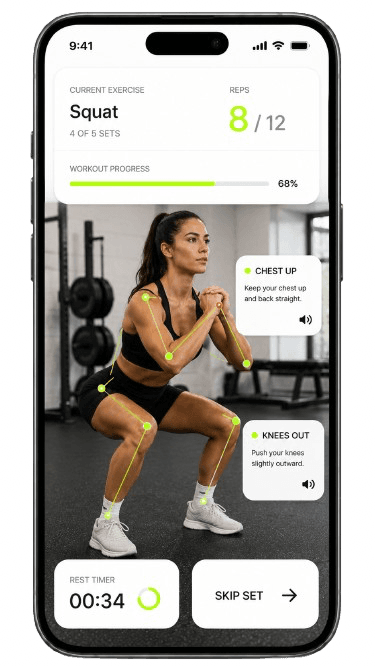
Real-time coaching on the iPhone you already use.
Boddy follows supported movement, counts repetitions, and delivers concise visual and spoken cues during the set.

Are Cluster Sets Worth Adding When Your Strength Workout Is Short?
Short answer: Usually not for the purpose of saving time. A cluster set breaks one planned set into smaller groups of repetitions, with brief rests inside the set. That can help you keep the later repetitions moving more like the earlier ones, but the best available comparisons have not shown a clear long-term strength or muscle-growth advantage over ordinary sets. If your session is short, first ask whether those extra pauses help a specific performance goal enough to justify the added time and complexity.
Imagine your plan calls for six repetitions of a lift. A traditional set is six repetitions in sequence, followed by the planned rest. A cluster version might be two repetitions, a 20-second pause, two more, another 20-second pause, then the last two. The total is still six repetitions; the pattern of rest has changed. That distinction matters when you compare results. Six unbroken reps and six reps with two rests are different tasks, even at the same load.
What has actually been compared?
A 2021 systematic review and meta-analysis combined 29 studies that compared cluster and traditional set programs lasting at least three weeks in healthy participants. Across the included studies, it found no clear between-method difference in strength, power, movement velocity, muscle size, or muscular endurance gains. The review combined varied ages, exercises, cluster designs, and program lengths, so the average result cannot tell you the best set structure for every lift or goal. It does challenge the blanket idea that adding short pauses reliably produces more growth.
A smaller eight-week within-person trial followed ten trained young adults. Each person trained one leg with 12 continuous repetitions and the other with three blocks of four separated by 20-second rests. Both legs performed the same number of sets and repetitions on unilateral leg press and leg extension, with loads adjusted to a similar reported effort. Ultrasound muscle thickness and regional lean tissue increased in both conditions without a detected difference between them. Ten people, two machine exercises, and eight weeks cannot settle what happens with every muscle or a much longer program. The cluster condition also used more total load across its repetitions, yet that did not establish a growth advantage in this study.
A newer six-week randomized squat study assigned 36 resistance-trained adults, including 15 women, to cluster or traditional sets. Cluster sessions generally preserved more barbell velocity and showed lower velocity loss, blood lactate, and perceived effort. Both groups improved one-repetition maximum and muscular endurance, with no clear difference in those longer-term gains. The researchers noted differing training histories and a short intervention; the study also tested a structured squat program, not a casual last-minute change to one workout. Keeping bar speed higher during a set is a real measured difference here. It is not proof that cluster sets improve technique, make every repetition safer, or make Boddy users stronger.
A decision rule for a 30-minute session
- Name the reason for the change. If your goal is simply to finish the planned workout on time, keep ordinary sets. Cluster rests add transitions. If you have a way to measure bar speed and specifically want to preserve it in one demanding lift, a planned cluster set may be worth testing.
- Keep the comparison fair. Use the same exercise, equipment, load, total repetitions, movement range, and rest pattern when comparing two cluster sessions. Do not call six broken-up reps a new six-rep personal record against a previous unbroken set.
- Count the whole cost. Include the short rests inside each set and the rests between sets. In the squat trial, several cluster-session rest schedules were longer than the corresponding traditional schedules; the result does not support treating clusters as a universal time shortcut (study protocol).
- Try one movement first. If the pauses make the session harder to follow or push out important planned work, return to straight sets. If they help you keep the intended rep pattern on a specific exercise, keep the structure consistent for a few sessions before judging it.
For example, suppose your first strength exercise is three sets of six and you have half an hour. You could keep the original three straight sets. Or, for one planned test, use two-plus-two-plus-two with two short pauses per set and keep the total repetitions unchanged. Log the structure explicitly in whatever training record you use. Next week compare that same structure, not merely the final rep count. Neither approach guarantees a better training result; the choice depends on what you are trying to measure.
Where Boddy fits
Boddy's current product description says the iPhone app combines workout planning and progress tracking with camera cues on supported movements. That makes it a potentially better fit if your main need is one place for the session plan, your completed work, and visible feedback during a supported exercise. Its camera guidance page also makes the boundary clear: one phone view cannot measure bar velocity or everything outside the frame. None of the cluster-set studies tested Boddy, and a camera cue is not a promise of better outcomes.
For an app comparison, JEFIT's own FAQ says it records sets and rest time but does not watch or assess exercise form. If you want visible cues during a movement Boddy supports, that is a concrete reason to choose Boddy. If detailed cluster-set timing and set analytics decide the choice, check those capabilities in each current app before switching; this article does not establish that Boddy leads on them.
Our live rest-between-sets guide explains the ordinary rest decision, and the working-sets guide helps you decide how much work to keep.
The decision: Use cluster sets to test a specific measurable performance goal, with the pauses planned and recorded. If the question is simply how to fit strength training into 30 minutes, start by protecting the most useful planned work and keeping the session simple.
BODDY IN ACTION
Real-time coaching on the iPhone you already use.
Boddy follows supported movement, counts repetitions, and delivers concise visual and spoken cues during the set.
TRAIN WITH BODDY
Want coaching that responds while you train?
Boddy combines personalized plans, meal logging, progress tracking, and real-time form guidance in one iPhone experience.