
THE BODDY JOURNAL
How to Return to Strength Training After a Long Break

BODDY IN ACTION
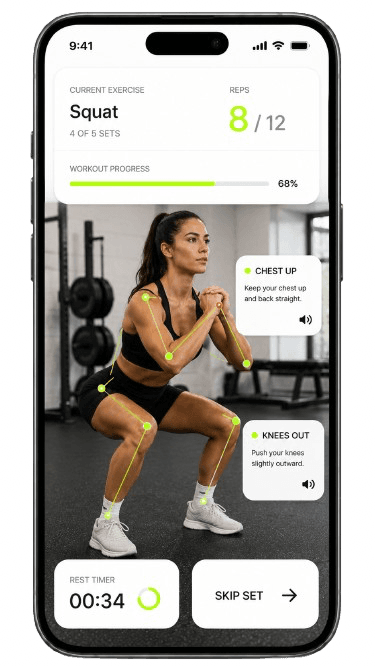
Real-time coaching on the iPhone you already use.
Boddy follows supported movement, counts repetitions, and delivers concise visual and spoken cues during the set.

If you have been away from strength training for months, your old loads and schedule are a record of what you once did, not a target for your first day back. Start with a smaller session, leave room to recover, and use what happens during and after it to plan the next one. You do not need to prove that you still have your previous capacity.
This guide is for an adult who paused because life got busy and currently feels well. If your break followed injury, illness, surgery, pregnancy, a new health condition, or advice to stop exercising, ask a qualified clinician what return is appropriate for you. A general article and an app cannot give medical clearance.
Choose a deliberately smaller starting point
The National Institute of Diabetes and Digestive and Kidney Diseases advises starting slowly and adding a little activity at a time. Its guidance describes strength work twice a week and notes that even one set offers benefits. That supports a modest first week; it does not prescribe a universal load or timeline for regaining strength.
Pick three or four familiar movement patterns: one leg movement, one push, one pull, and perhaps a hip or trunk movement. Use equipment you can set up confidently. A leg press, machine chest press, seated row, and a comfortable hamstring curl are one possible gym combination. Body-weight, bands, and other machines can work too. If an exercise is unfamiliar, choose a simpler option or ask gym staff to show you the equipment.
For the first session, do one controlled set of each movement with a load that feels clearly easier than your former working weight. Stop while you could likely do several more good repetitions. The point is to learn your current tolerance, not test a maximum. A few minutes of easy movement before lifting can help you settle into the session.
A sample first two weeks
| Time | Strength plan | What to notice |
|---|---|---|
| Week 1, session 1 | Three or four familiar movements, one easy set each | Control during the set; how you feel later and the next day |
| Week 1, session 2 | Repeat after a recovery day or more, adjusting down if needed | Whether the same work feels manageable again |
| Week 2 | Repeat two sessions; consider one extra set for one or two movements only if week 1 went well | Whether the added work still allows comfortable recovery |
This is an example, not a medical prescription or a promise that everyone should progress in week two. Walking or other comfortable activity on nonlifting days can be useful, but you need not add it to make the strength plan count. If your schedule only allows one short session at first, begin there and build a repeatable routine.
Judge the response before adding more
Write down the exercise, equipment setting, load, repetitions, and a brief note about effort. Check how you feel that evening and the next day. Ordinary muscle tenderness can follow an unfamiliar session, but new joint pain, symptoms that disrupt normal activity, or worsening symptoms are reasons to pause and get individual advice. NIDDK's activity safety guidance discusses easing off when activity causes pain and seeking help for warning signs such as chest pressure, severe breathlessness, or dizziness.
If both sessions felt manageable, change one thing at a time: an additional set, a few repetitions, a small load increase, or more frequent sessions. You do not need to add all four. If recovery was poor, repeat or reduce the previous dose. Our starting-weight guide explains how to select a controllable load, while the two-day strength plan offers a fuller ongoing weekly structure once the return feels stable.
Keep the goal distinct from a missed-week restart
Returning after months away is a question about current capacity and training dose. Missing one ordinary workout is mainly a scheduling question; our consistency guide covers that situation. If you trained regularly before the break, you can still use familiar exercises, but do not assume the previous number of sets, load, or recovery pattern fits today.
Consider a person who used to lift four days a week and stopped for five months. On Monday they do one easy set each of leg press, row, and chest press. On Thursday they repeat, reducing the leg-press load because the first session left them unusually tired. They record both sessions. The following week they keep the same three exercises and loads; only after that feels comfortable do they add a second row set. Their old four-day split stays on the shelf until their present routine supports it.
Use Boddy as a record, within its limits
Boddy can help you choose a plan around your current goals, schedule, and available equipment, then keep a record of movements, loads, and repetitions. Use your present training notes when deciding what to repeat or adjust. Camera cues apply only to supported exercises and visible movement; they cannot judge whether you have recovered from an injury or are medically ready to train. If you want a place to plan and log the gradual return, get Boddy on the App Store.
Sources
BODDY IN ACTION
Real-time coaching on the iPhone you already use.
Boddy follows supported movement, counts repetitions, and delivers concise visual and spoken cues during the set.
TRAIN WITH BODDY
Want coaching that responds while you train?
Boddy combines personalized plans, meal logging, progress tracking, and real-time form guidance in one iPhone experience.